Sunday, January 9, 2011

"Up" to the Angel (4-8 January 2011)


South America is bigger than Ben Hur! Here is another example. My journey from Rio Mutum Lodge in the Pantanal of Brazil (last blog) to Parakaupa Lodge in Canaima Venezuela (this blog and base camp for Angel Falls) took a total of 2 days and 1 hour, involving 9.5hrs flying over 4 flights, 3hrs by car and 2 nights in Cuiaba Brazil and Caracas Venezuela. See NOTES TO SELF below for more details.

Cuiaba is a disorganised, grubby, hot-muggy-as-hell industrial town, 3hrs drive from Rio Mutum with nothing to see - it is the worst city/town I have seen to now but it had cheap wine!

My first impressions of Venezuela were as I expected - run down, bureucratic, not quite used to tourists and probably like Cuba! Domestic Caracas airport is grossly outdated and now I know where all the world's old airplanes go! Dirt covered DC9s & 727s everywhere. One of those was the "Aeropostal DC9" that I flew to Puertos Ordaz on my way to Canaima! Big queues at Caracas airport for everything, super slow customs, 50 taxes to pay and 70 stamps to get...etc. Outside is poverty with a capital "P"!
On my first night (4JAN), I stayed 20min west of the airport on the coast (Carribean Sea), some 40km from Caracas at Playa Escondida - OK beach but surroundings look like war-torn Beirut. My hotel was like Stalag 13 on Hogans Heroes - barbed wire fence with security gate - who the hell were they trying to keep out? I went for a run and all I saw was chaos! No one obeys the traffic rules, no one uses blinkers and most do not turn on their head lights at night. Still, it was a better run than Bangkok.

The capital and largest city, Caracas (Pop 6m) is rated the second most dangerous city in the world after Mexico City (crime rate per head of population). It has more murders and kidnappings than Columbia - most of this is linked to the high poverty rate. The city itself is 900m above sea level giving it some relief from its tropical latitude. The city centre does not have street addresses but "corners", eg: William / Park means building is located between the two. How odd is that? Most of the city and indeed the country is dedicated to one man - Simon Bolivar who liberated Venezuela from the Spanish. Everything is named after him - airport, plazas, cities and even the currency (Bolivars).

Canaima (Pop 1,500), 2 hrs flight from Caracas via Puerto Ordaz, is 50km from Angel Falls and its base. There is no road or rail in/out of Canaima making it trully remote. The only way to get to Angel Falls from Canaima is by Cessna, Boat or foot (5-10 days). Canaima has a fantastic lagoon with 7 waterfalls and the water is tea coloured due to all the tannins from the dead jungle vegetable matter soaking in the waters upstream It was weird swimming in it since underneath it is pitch black!


Canaima and the Angel Falls is located within the 30,000sq km UNESCO protected "Parque Nacional Canaima" (size of Switzerland) and pours off a huge 1,050m enscarpment or saddle which the Pemon call "Auyan Tepui". Tepui is Pemon for "flat mountain". I walked to each of the Canaima 7 waterfalls, swam under 2 and walked beneath another 2.


At 6deg north of Equator, Canaima National Park is tropical, a bitch to run in and home to species of 145 mammals, 495 birds, 70 reptiles and 60 amphibians. Canaima is a village of 2,000, inhabited and run entirely by the local indigenous Pemon people. They run all the tourist lodges, shops and airport. The town is supplied with electricity from a mini-hydro-electric turbine off the 7 water falls!

The first time I laid eyes on Angel Falls was at 1:15pm Wed 5JAN out of a six seat Cessna Skymaster at 4,000 feet (level with the top of Angel). It was like a skyscraper of water surrounded by King Kong style jungle from the Dinosaur days! There was almost a spiritual reverance about it. I got goosebumps! Thinking about its sheer majesty and how hard it was to get here, reminded me of the children's animated film "Up", that I watched just before my trip with my nieces Antonia and Orlanda, that followed the incredible journey of an old man to "Paradise Falls" (Angel Falls) using his house tied to balloons, to fulfill his late wife's life-long desire to realise the ultimate adventure. This Angel stirs the emotions. It is a jungle god in a land that time forgot!
If you were a droplet of water in the Angel Falls you would travel 979m before hitting the bottom! That's the equivalent of 4 Sydney Centrepoint Towers or 16 Niagara Falls. No wonder Angel Falls is the highest in the world - by a country kilometer!!! This is so high that there are many days in the dry season when the water does not reach the bottom but is blown away as a fine mist! The Cessna ride was exciting but too short, lasting only 30min. The pilot, myself and a family of four from Poland circled once and we mainly saw the Angel through our camera lenses. Even though I enjoyed a fabulous view of the whole valley of Tepuis, I was determined to see the Angel up close and personal by boat and then foot!
I was lucky enough to book a boat trip including an overnight stay in a hummock at the Angel! Myself and 10 others from Venezuela, Belgium, Italy and Brazil set out the next day (6JAN) at 8am on our 4hr boat ride and 1hr trek to the base of Angel itself. What a trip. Rapids, getting wet, rocks, thick jungle, magnificent views of the sourrounding flat top Tepuis. I became Indiana Golfin! Finally we arrived at our riverside camp and set out on foot through thick jungle covered in tree roots and filled with the noises of a million creatures!
Suddenly, after an hour, you emerge from the darkness of the jungle into a massive open cliffside face to peer directly at the feet of the Angel with the falling water towering above you like Irwin Allen's Towering Inferno. The experience was like seeing the 3 towers of Torres De Paine. Simply sereal. Simply pre-historic. After a thousand photos we then walked back into the forest to walk a bit further emerging at the cascade not immediately under the main fall but a km downstream where the water aggregates and forms a secondary spill. We all stood underneath it. Such power. Such reverence.

That night, like the conquering Spanish, we feasted on Venezuelan-style BBQ chicken cooked on sticks leaning into a roaring fire. All the local Pemon took care of us. They ran the boats, cooked and served the meals and made a great enterprise of the whole thing. In the meantime 8 loud-mouth Italians, 2 Dutch, 3 Brazilian and 1 Australian carried on into the night.
We finally retired to hammocks under a huge, open-air, corregated fibro covered shed in the jungle and on the river overlooking the Angel. I slept only half the night in the bloody hammock since you cannot sleep on your stomach but the consolation was the steady pitter-patter of rain on the corrogated roof to lull us to sleep. What a dream - to walk "Up" to the base and then sleep under Angel Falls!
VENEZUELA FACTS: 1) Covers 912,050 sq km above equator, twice the size of California, with 2,813km of coastline. 2) Population is 26.8m with 95% Catholic, 50% under 25yrs old, 90% living in cities, 70% originally from Europe/Africa/Indigenous and 30% living in poverty. 3) Originally settled 10,000yrs ago via 3 indigenous groups. 3) Christopher Columbus founded in 1498 and first saw indegenous living in huts over water so called it "Little Venice" (Venezuela). 4) First Spanish colony established 1500. 5) Simon Bolivar achieved independence in 1821 with mostly coups / military rule afterwards until the first democratic election in 1947. 6) Oil discovered in 1910 led to Venezuela becoming the no 1 exporter globally in 1920. 7) Since then governement corruption has sent the country downhill and by 1998, two-thirds of the 23m pop were living in poverty. 8) No 1 sport is baseball, no 2 is basketball and no 3 is soccer! 9) Has won the most beauty paegents in the world (5 Miss Worlds and 5 Miss Universes). 10) For its size, it is a wildlife Noah's Ark, species: 341 reptile, 284 amphibians, 1,791 fishes, 351 mammal & 1,417 bird (20% of world's total!).

NEXT BLOG: On Quito and Galapagos Islands (belonging to Equador) due 13JAN11.

ACKOWLEDGEMENTS: My thanks to Lilly Verhagen from Holland doing her medical PhD in Venezuela, who took the time and patience to take the "drink photo" signature shot of me at Angel Falls in this blog. She also is in the running for "best signature" shot.

HINTS & TIPS: 1) There is no such thing as an "on-time" flight in South America. It is not a question of "if" late but "how long". Book the maximum connection time possible even if you have to overnight. Connections of 3hrs or less - good luck! I almost missed two connections to date, one was 5.5hrs and the other 3hrs! 2) I recommend the overnight boat trip as the best way to see Angel Falls. It gets you the closest to the falls, maximum time there just in case it is in clouds and you get to swim and sleep at the falls. If you hate hammocks then take the boat day trip. Book and pay for boat when you are in Canaima at any of the lodges - Waku is the best at www.wakulodge.com or my lodge at www.parakaupa.com.ve. If you hate getting wet on the boat or do not have time then take the plane as a last resort but be warned that it is expensive, quick and the photos may come out spotted since most Cessna windows are scratched. At least the plane will give you a guaranteed view since the pilots call your lodge when conditions are best to go.
NOTES TO SELF: 1) Remind me never to put red wine in my main pack again. After unpacking at my Caracas hotel I discovered 1 of 2 bottles smashed. Lucky for me my towel, undies and runners (instead of pants and shirts) absorbed the spill - I spent most of the night of 4JAN washing! 2) Unlike Spain in Europe, no one claps when the plane lands safely! 3) Venezuela prices: fuel is only 30 cents a litre! 330ml water is $1, 330ml beer is $2. 4) Pantanal to Angel: 3hrs drive to Cuiaba for overnight, then 2hrs 737-700 to Sao Paulo, then 5.5hr 737-800 to Caracas for overnight, then 1hr DC-9 to Porto Ordaz and finally 1hr Jetstream-18 Prop to Canaima!

Tuesday, January 4, 2011

...and a Pantanalian New Year !!! (30 December 2010 - 3 January 2011)

"Feliz Ano Nuevo!" (Happy New Year!) from "The Pantanal" in Brazil!

I celebrated the arrival of 2011 with a "Brazilian Beetle" firmly biting my hand!!! This bug was served to me for desert after midnight by my new found friends in Brazil as a joke - more on this later!


New Year for me was defined by a traditional Brazilian feast, music and dancing (Carnivale), in the wild, at the "Pousada Rio Mutum" which is an "ecolodge (pousada)" on the river Mutum, 130km south of Cuiaba (Pop 527K) in the state of Mato Grosso near Mimosso and the geographic centre of South America. Owner, Alice Galuao, her daughter Estephania and their wonderful staff put on a night I will never forget. Aside from my own family and friends being absent, it was probably one of the best New Years I have ever had. Here am I thinking...what will I do?

Approx 30 guests feasted on 8hr oven-roasted lamb, pork, beef and fish accompanied a myriad of side-dishes and plenty of local beer and "Cachaca", the 39% local spirit! The only meat Brazilan's do not eat on New Year's eve is chicken since it steps backwards as it eats, so no Brazilian wants to go backwards in the new year (Julia Gillard's moving forward theory in reverse!). The bug on my hand was a great dinner joke until I tried to kiss it and bit me! It would not come off! Finally when someone revealed a cigarette lighter to burn it off, it released all by itself! It must have understood what the words 'BIC" mean!!!

Rio Mutum Ecolodge and others like it, are designed to expose guests to the rich flora and fauna of the Pantanal of Brazil via guided treks, boat trips, horse-back riding, spotlighting and 4-wheel driving. Rio Mutum lodge comprises 22 individual aircon cabins, a huge dining hut, a big TV and games hut, an outdoor lounge and even a pool and spa. And yes, the www is accessible!!! Rio Mutum ecolodge is located at the bottom of the Amazon so a lot of its vegetation and wildlife is actually present.

Put bluntly, the Pantanal is a swamp the size of New South Wales with a shitload of exotic wildlife in it!!! It is the world's largest wetlands covering 230,000 square kilometers with a living thick pea soup of exotic animal species, including 650 bird and 80 mammal. Specialties of the house include the "Capybara" (world's largest rodent, up to 1m long!), "Jacares" (or Caiman alligator, up to 6m long!), "Rhea" (1.4m high flightless bird), the largest stork in the world, macaws, anteaters, giant armadillos, jaguars, ocelots, pumas, tapirs and the capuchin monkey. 469 of the 650 bird species can be seen in and around Rio Mutum and I was lucky enough to see 49 of these over the 3 days and nights that I spent there. Rio Mutum is particularly memorable because at 7pm, each day, without fail, they serve up Piranha soup! Yes, you heard right...and it is delicious!

To get here I had to endure 23.5hrs of travel door-to-door from my hotel in El Calafate to the ecolodge in Rio Mutum with 9 of the 23.5hrs spent in the air on 4 different flights and a 3hr drive from Cuiaba. Trully the middle of South America. It was so remote I saw a 2 metre anaconda, which I chased, approx 4km from the lodge. As soon as I arrived, in true Golfin travel style, I jumped on a horse and with my new-found friends Vicky and Graeme from Johannesburg South Africa and guided by Raul, we embarked on a 3hr ride through the surrounding wet-lands. My horse almost dumped me when it jumped up, having come across an alligator under water! We would have seen around twenty different types of birds and a brilliant sunset to farewell 2010.

New Year's day saw me up at 11am and what better way to shake off all that Brazilian food and grog than a 50min run in 32C muggy tropical heat! I died. However, I came back to life in the afternoon when we went on a 4hr 4-wheel drive trek 30km north of the lodge. Amongst the many bird species we saw a macua, touchan, crab-eating fox and wild pigs. It rained all the way back. This is the wet season and like Darwin and Singapore the day is sunny with arvo or overnight rain. By March, the whole area is almost totally flooded with water lines rising up to 3-4m. The Pantanal is an ornithologists (bird scientist) paradise. My companions, Vicky and Graeme, who were there for 4-5 days, saw a total of oevr 105 species of birds. Un-belieeeeevable!

Sunday 2JAN11 was a great day. Alligator and monkey day! Vicky, Graeme and I set out on a 3.5hr boat cruise with Raul and "Captain Niko" deep into the Rio (River) Mutum. The place is swarming with Jacares (black alligator). We got so close, that I could reach out and kiss it! In fact, I swam towards one! You will have to wait for Golfco Pictures to see that one! As always, we saw countless birds. I went for another 32C run over lunch in-time for another 3.5hr afternoon boat trip to another part of the Rio Mutum where we disembarked and went on a 2hr walk where we encountered 2 of the 4 types of monkeys in the area. We also saw a number of new bird species.


On the way back we spotted a family of the world's largest "rats", YES, without the tail! They look more like pigs as you can see in the photo! At the end of our boat cruise, we witnessed one of the grandest sunsets of our lives and a super-fluoro-green Iguana! But that's not all. After another wonderful dinner, we embarked on a 1.5hr spotlighting 4-wheel drive. Managed to see an anteater and a Brazilian "scorpian".


Monday 3JAN11 was my last day and featured a 2hr walk surrounding the lodge. Managed to see some monkeys and the "Anybara", a small possum like mammal! I was sad to say farewell to Vicky and Graeme (who had just completed 8.5mths worth of travel in Africa and South America!!!), Raul, the staff of Rio Mutum Ecolodge and the 49 species of bird, 3 reptiles and 6 mammals that I saw in just 3 days!


BRAZIL FACTS: 1) Brazil is the world's fifth largest country and covers almost half of all of South America! 2) Population is 199 million making it the largest Catholic country in the world. 3) It is the only South American country that speaks Portuguese with 180 different dialects. 4) Has 7,400km of coastline, most with powdery white sandy beaches. 5) Since a massive underwater oil field was discovered in 2007, its economy is now number 8 in the world, hyper-inflatuation has ceased all debts paid off but the divide between rich and poor is second to only India. By 2020 Sao Paulo is expected to be the world's 13th richest city. 6) Has won five FIFA World Cups (the most) and is hosting the next in 2014. Rio is also hosting the Olympics in 2016. 7) Indigenous people first setlled here 50,000yrs ago with 1,000 tribes when Portuguese arrived in 1500AD. 8) 6% of the current population is descended from Black Africans, 3.5m of whom were brought in as slaves between 1550-1888 to work plantations and then mine for gold. 8) Independence from Portugal came in 1821 with 1889 being the end of the local monarchy. Since them Brazil has been mainly controlled by the army and factions until the 1990s when democratic elections became the norm.

NEXT BLOG: On Caracas and Angel Falls in Venzuela due 8JAN11.

ACKOWLEDGEMENTS: 1) My operatic thanks went to Alice Galuao (Rio Mutum Ecolodge Owner) for putting on such a wonderful feastive New Year's Eve for a bunch of travellers so far from home! Many thanks to Denise, Edwardo and his staff, Captain Niko and finally Raul for his patience and knowledge in guiding us through so much wildlife! Pantal Power!!! 2) My personal thanks to "Carla" from Hosteria Lupama in Ell Calafate for her great English and efficiency and letting me check out late on the last day!

RELATED LINKS: Learn all about Rio Mutum Ecolodge at http://www.pousadamutum.com.br/

NOTES TO SELF: Argentina price samples: petrol was $1AUD a litre, bread $2, milk $1, 750ml beer $1.50, most wine $4-$10, tomatoes 1.50/kg, most tinned food around a $1-2. Brazil even cheaper except for petrol at $1.80AUD/Litre designed to pay baack Gov debt.

Thursday, December 30, 2010

A Merry Patagonian Christmas and... (24-29 December 2010)

On Christmas Day there was no seafood or barbie for me! From 7.10am to 5.50pm, I trekked a total of 28km, up and down narrow, rough, rocky terrain. 13 of the 28km was with a 25kg pack on my back. I weighed 63kg at the time. Was I out of my mind? Not exactly. Unfolding before me was the trully breathtaking geographical magnificence of the Torres Del Paine National Park in Chile! This is the crowning area of a region known as "Patagonia" which is shared by Chile and Argentina and was first visited by the Spanish explorer Sir Ferdinand Magellan in the early 1500's. Legend has it that Magellan named the area "Patagonia" because the indigenous people he met were so tall they had HUGE feet, since in Spanish, "Pata" is a foot and "onia" is BIG!

Patagonia is almost treeless. It is officially a "steppe" which is like a vast semi-arid desert or olive drab hills with clay and sand (like a tundra). Wildlife include "Guanaco" (look like Llama but are actually in the camel family!), fox, condors (like vultures) pumas (rare) and the "Huemul" or Andean Deer (also rare). The key flora is the "Calafate Berry", like blueberry, used to make jam, ice-cream and even liquer. Patagonia is famous for its "Estancias" or sheep ranches which average 10,000 acres just like the stations in Oz. They are big! Patagonian lamb tastes just like Australia's.

Every cloud has a silver lining. Here is how my Christmas saga went from back-breaking to wine and song!

On Christmas eve, I flew 1.5hrs from Ushuaia to El Calafate in Argentina. From there, I took a minibus tour with 8 others and we drove 3hrs to enter the Torres Del Paine National Park in Chile (UNESCO pretected, covers 181,414 heactares formed by volcanic eruption 12 million yrs ago). Our minivan tour visited several lakes and took in views of the "Paine Massif" (literally "big blue bolders") and the famous three "Torres" or "towers" which I would hike to later. After a lovely panoramic lunch, I was dropped off at Lake Pehoe to start my trekking adventure. I went for a run before catching the boat across to Refugio Paine Grande (my first night camping) but I got caught in 70km/h winds which is typical for this time of year. After a night of howling wind and rain in my tent, I greeted a grey, windy Christmas morning as I started my 5hr trek to Grey Glacier and back (ohne pack!).


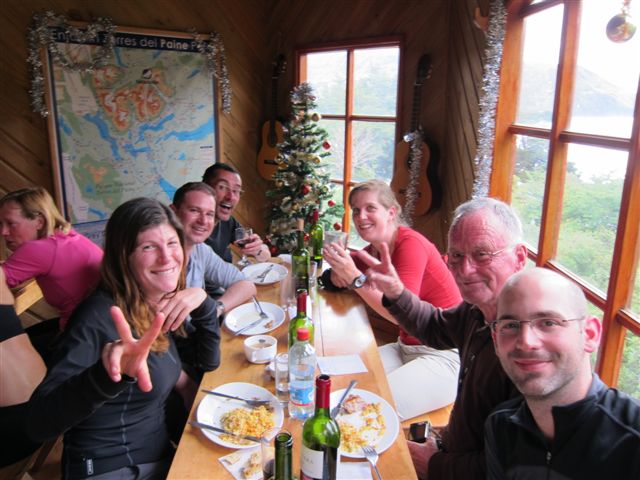
My 5hr, 20min trek from Refugio Paine Grande to Refugio Los Cuernos was simpy back-breaking. However, things got better. The sun was out and it was warm enough to go shorts and T-Shirt. Unreal. I spent Christmas evening in Refugio Los Cuernos by Lake Nordenskjold with massive snow covered mountains through the windows outside, a Christmas tree on my left and a Dutch couple, an older German guy and one willing Chilean gal on my right, washing down BBQ Pork and Chilean "fried rice" with gallons of "Tres Medallas" 08 Cab Sav from maker Santa Rita in Valle Central, Chile (lunch red, ripe fruit but no body). The German guy at dinner was a former executive of a big German car maker. The Chilean girl was his personal "guide". He would not reveal his true identity. Yeah sure, "I like to have relations!"

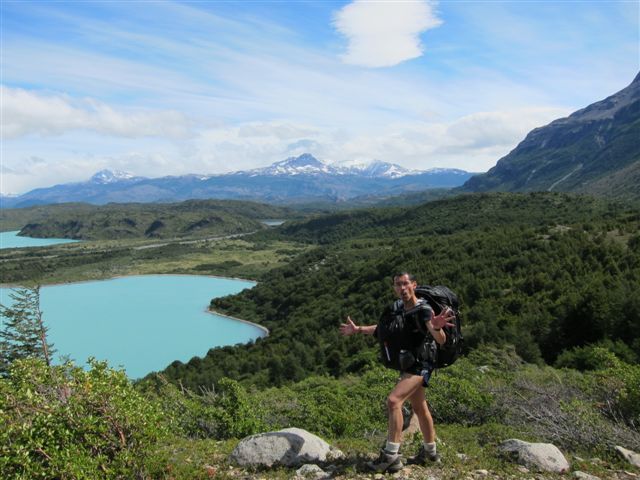
Boxing Day saw me wake up from my second tent night (slept like a dead man!) and then trek another 11km over 4.5hrs to Refugio Torres Central, right under the 3 granite towers that make this place so famous. The Torres Refugio is classy. I get a bed in a room with 3 others! Along the way to Torres, Thomas, a Chilean-would-be-sherper, offers to take my 7kg day pack (with all electronic gear and documentation) to lighten my load - what a glimmer of human hope! I was impressed. I did not give it to him. I made this cross and I had to carry it!


The morning of 27DEC saw me into my "summer" running gear and at 8am I headed off to the base of the 3 towers. The sun was out, no wind and the towers in no cloud - perfect. The map quotes 4.5hrs to do the 9km trip from the Refugio 137m to the 886m viewpoint. I did it in 2.5hrs via a combo of running and fast trek climb. The view from the Torres Mirador (Spanish for Towers Viewpoint) simply takes your breath away - again I land on another planet - it is easily the most spectacular trek and view in my life so far!

The 3 granite towers are jagged and have an alien look about them. The highest one is Torre Sur at 2,850m. The lake in the foreground completes the picture. The return trip is all jog and takes 1.5hrs! I took one stack at Refugio Chilean, where I lost my camera but realised it immediately and collected it! Lucky. The entire return run was exhilarating but very painful! Since my time back was much quicker than I expected, I went on another trek.

This time slow and easy from 1:50pm to 4pm on the track to Campamento Seron which is part of the "perimeter track" that encircles the entire park. I am now back at Refugio Torres Central soaking my feet and my mouth in lovely Chilean Sav Blanc! It is 10pm and 52yr old Dutchie "Kristina" shouts me several red wines after singing in Spanish to the entire kitchen (4 cooks and 8 staff)!


The 28DEC was a rest day because I could not walk. I finally push myself to do a run around the camp and then head off on a 9hr bus ride to El Calafate which should have taken 5hrs! Welcome to South America!


The next day is perfect. Blue sky, sun, 20C and the Perito Moreno Glacier, 83km away looks spectacular. It has a 5km face, up to 60m high, 33km long and advances 30cm a year (this is fast, most glaciers do only mm). Seen one glacier, seen them all? No. This one is special because it looks great and "calves" (huge chunks of it fall into the lake) around a dozen times a day. Golfco Pictures managed to film one and it was big according to our guide! The one hour boat ride to the face finally put its size into perspective.

As you can see from the photos, the Torres Del Paine National Park and Perito Mereno Flacier was EXACTLY the magnificent places I expected. Except for that bloody 25kg back pack!
ACKNOWLEDGEMENTS: Congratulations to Eliana Braga from Fortaleza Brasil who took the "lick photo" in this blog - easily the best one so far. She is in the running for Golfco Pictures "Best Signature Shot" of this trip!

NEXT BLOG: "...and a Pantanalian New Year !!!" due 4-5JAN11.

NOTES TO SELF: 1) I saw Thomas again, 10min into my return jog from the towers - what a coincidence! Did not stop to talk because joggers time trial rules must be obeyed - at all costs!

HINTS & TIPS: 1) Refugios Cuernos and Torres take credit cards! 2) Set out early. If weather goes bad it is typically after 4pm. 3) Better to book and pay for all day trips when you are there - tons cheaper! 4) I did not have time but go to El Chalten to see Mount Fitz Roy (3,405m).

Friday, December 24, 2010

Planet Antarctica (13-23 December 2010)

Antarctica is like no other place, I and my fellow travellers, have seen on earth. Quite literally, it is another world! What makes it this way is that it can be astonishingly beautiful one minute and absolutely unforgiving the next. Despite this, life has found a way to exist here and abundantly. It is the combination of massive snow covered peaks, multiple glaciers, thick sea ice, huge shapely icebergs and multiple wildlife that makes Antarctica unique. I also imagine that the last ice age must have looked like this over the rest of the earth.....another world, another time!


In total, we travelled 3,087km as far south as 65deg, 10min (170km from Antarctic Circle and 2,500km from the South Pole), seeing 37 species of wildlife (3 whale, 5 seal, 5 penguin, 24 bird). The best aspect of our trip was the 1 in 10 chance of getting mostly sunny weather and this allowed us to make all planned 10 landings over 4 days on Planet Antarctica: Aitcho Island, Cuverville Island, Neko Harbour, Wiencke Island, Pleaneau Bay, Petermann Island, Port Lockroy, Paradise Bay, Deception Island and Half Moon Island. I trekked around 15km over 4 landings, kayaked approx 10km over another 4 landings, camped one night, jogged 4km on the continent and even went for a 20m swim!

To get to Planet Antarctica you must cross the infamous Drake Passage. This would be like going to the moon in a space craft. In our case, we did it aboard the Canadian owned "MS Expedition" carrying 103 passengers and 65 staff from 25 countries around the world. We even had aboard the first Turkish citizen, Nurettin Yilmaz, to ever set foot on the continent. I was lucky to meet him and he will be interviewed by the Turkish media when he gets back! He even planted a Turkish Flag on the continent. We left Ushuaia at 6:15pm on Tuesday 16 December 2010. Ushuaia is around 1,000km from Antarctica.

The MS Expedition was built in Denmark in 1972 and refurbished in 2009 - it is 105m long, 19m wide, weighs 6,334 tons and cruises at around 15-20km/h. Even a ship this big, rolled around on our 36 hour Drake Passage crossing from the bottom tip of South America to our first stop in the South Shetland Islands, just 12 hours away from the continent. The Drake Passage is wild. Waves can reach 12m and winds up to 150km/h. We were lucky not to get these but it was still a rolly polly ride for most who struggled to keep dinner down! Even in these conditions we were able to see many sea birds including the Wandering Albatross with a wing span of up to 3m, weighing up to 13kg and spending many years flying thousands of kilometers out here - simply amazing. Alone, alone, alone on the wide, wide sea!

The MS Expedition is entirely staffed by 48 constantly smiling and hello-ing cooks, cleaners, waiters and deck-hands from the Phillipines! These guys typically spend 8-10 months away from home travelling the Arctic and Antarctic. There are 7 officers and a further 12 non-Phillipino "expedition crew" and one musician to provide us with information and entertainment. Amongst these are a qualified geologist, biologists, naturalists, historian and one of the world's foremost ornithologist and Penguin expert! All gave interesting and often funny "lectures" on all aspects of Antarctica during the Drake crossings and in-between landings. Landings were a slick logistical operation, moving 103 people to shore in just 20min using rubber inflatable dingies called "Zodiacs" (after the manufacturer).


Landing No 1 - Aitcho Island, South Shetland Islands (UK), Noon-3:00pm Thursday 16 December 2010, Trekking 1:
Aitcho is a tiny island of Penguin paradise! There are 17 species of Penguin in the world and we saw a total of 4 on our trip with 2 on this island: the "Gentoo" (orange beak) and "Chinstrap" (black line under chin). All were nesting, most had two eggs and many even had chicks! They build their nests on ice/snow-free ground using a pile of small stones. Both sexes incubate the egg which takes 35-37 days to hatch. Penguins eat krill (small shrimp-like creatures), smell and we are told they taste like shite! We also saw "Shags" (medium-size black & white birds) on a rock, "Southern Giant Petrels" (big birds who eat anything) and even "Southern Elephant Seals" (or odipherous blubber slugs) which pile up on each other and burp on the beach!


Landing No 2 - Cuverville Island, Gerlach Strait, Antarctica, 9:00am-11:30m Friday 17 December 2010, Kayaking 1:
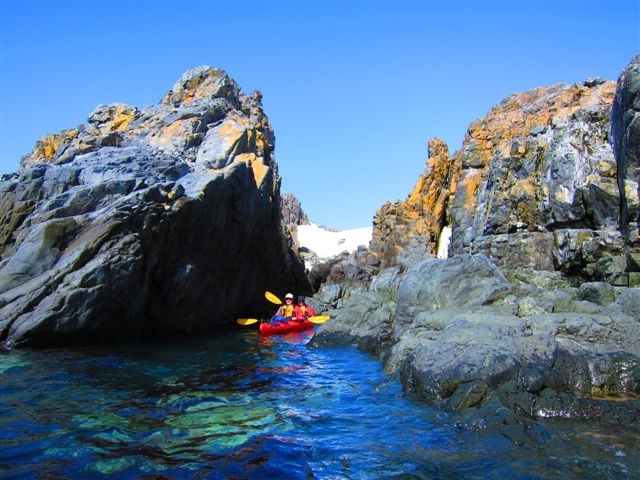
This was my first kayak amongst massive, unusually shaped ice bergs. There were 10 of us kayaking with the rest hiking a steep 130m hill on Cuverville and observing penguins, seals and birds. Kayaking on Planet Antarctica is surreal. You are surrounded by massive ice sculptures, creaking with deep blue fissures above water and fluoro green extensions below you. Penguins "porpoise" (jump) out of the water all around you looking for krill and the occassional seal stares down at you with cute cow-like eyes, lying on top of a berg or ice-sheet.


Landing No 3 - Neko Harbour, Andvord Bay, Antarctic Continent, 2:00pm-5:00pm Friday 17 December 2010, Jogging:
This is where we layed our feet on the actual continent! Whilst everyone climbed the 130m hill overlooking the harbour, I jogged 4km, up and down this hill, 4 times in the snow over 30min. My official run of the 7th continent was bloody hard as my feet sank in the snow, one out of every 5 steps but it was exhilarating. Another ozzie girl, Tanya from Melbourne ran a single lap up and down. Most of us just sat at the top of the hill admiring the view for almost 2hrs, coming to terms with the fact that our feet were connected to the South Pole!

Landing No 4 - Damoy Refuge, Wiencke Island, Dorian Bay, Antarctica, 9:00pm Friday 17 December 2010 - 5:30am Saturday 18 December 2010, Camping:Since the hut was out of booze, I came to the rescue with some Argentinian Malbec from Mendoza which was enough to fuel jokes and chit-chat until sunset at 12:50am and beyond. Most of us slept a few hours and some stayed up to watch the sun come up at 2:20am. It actually does not get dark in between and there is plenty of white light - constant day for at least 4 months in summer! We also set up our porta-loo next to the hut since you cannot leave any human souvenirs anywhere in Antarctica. The next morning it was freezing and we packed in record time to get back to the ship by Zodiak for a hot tea and shower!


Landing No 5 - Pleneau Island, Penola Strait, Antarctica, 9:00am-11:00am Saturday 18 December 2010, Kayaking 2:
Penola Strait is packed with peaks, glaciers, sea-ice, pack-ice and bergs. It is the quintessential Antarctic landscape and the sun made it ten times more spectacular! Kayaking across calm waters revealed ice bergs and whole mountain peaks and glaciers reflected in the water. Being away from the ship and people allowed us to hear the thunder of distant collapsing glaciers and the creaking of pack-ice. Kayaking activities included dodging bigger ice pieces, running over smaller ones, passing under arches in some bergs, licking the walls of others and singing into berg caves and fissures. The other passengers observed this icy lamington wonderland on the Zodiaks as there was nowhere to trek.

Landing No 6 - Petermann Island, Penola Strait, Antarctica, 3:00pm-5:30pm Saturday 18 December 2010, Trekking 2:
Petermann is a few kilometers south of Pleneau and was the most southern point of our trip: 65deg and 10min, only 2,500km from the South Pole. Petermann is also rich in wildlife and nesting site of Adelie Penguins which we saw. Kayaking was cancelled due to too much ice and we joined the others on a fabulous trek through this rich potpourri of wildlife. What made this island spectacular was its close proximity to the huge peaks and galciers of the continent and the myriad sea of ice in between.


Landing No 7 - Goudier Island and Port Lockroy, Jougla Point, Antarctica, 8:30am-11:30am Sunday 19 December 2010, Trekking 3:
This landing actually comprised two sites near each other. Half went to one and half to the other and then we all swapped by Zodiac. Goudier Island and Jougla Point was a show case of penguins and old whale bones from the whaling era before World War II. Port Lockroy is the location of a penguin research station and the world's most southern functioning post office run by England.

It is staffed from November to March each year and also contains a souvenir shop to fund research actvities. I along with many others, wrote two post cards and mailed it back to Sydney (brother) and Melbourne (Myer) from a post box in this very location using specially commissioned Antarctica stamps!

Landing No 8 - Chilean Naval & Air Force Base, Waterboat Point, Paradise Bay, Antarctica, 4:00pm-5:30pm Sunday 19 December 2010, Kayaking 3:
Whilst most people visited the active Chilean military base and museum, we kayaked across the bay to mainly observe wildlife on the shore. There was limited ice bergs and ice sheets in this area. This was also the site of the "vanilla" penguin, same as the Gentoo but a beige or vanilla colour replaces any black markings.


Landing No 9 - Whalers Bay, Deception Island, South Shetland Islands (UK), 9:00am-11:00am Monday 20 December 2010, Trekking 4 and Swim:
This was the only landing with cloud, mist and a short snow fall. Deception island is the "Santorini" of Antarctica. Like its Greek counterpart, it is a submerged, crescent shaped island caldera formed by a massive volcanic eruption and able to support a ship navigating and anchoring inside.


This island has black volcanic sand beaches, still steaming from subterrainian thermal activity and surrounded by snow covered peaks! Not exactly Santorini! This island was home to a major whaling station where whale oil was produced and stored from the 1930's to the end of World war II. It was then used by the British Antarctic Survey until 1969 when a minor eruption caused its abandonment. It is spooky place, full of broken huts, old boats and acres of whale bones. After viewing penguins and an abundance of lichen and algae we visited the abandoned whale processing boilers, tanks and huts.

To finish, around a dozen of us stripped down to our cozzies (and some did undies) and dived into the 1.5C water! I swam 20m until my head almost exploded! In the water your body feels like it has no limbs and when you get out of the water it feels like there are thousands of slaps and pins and needles all over your body. You then loose sensation in your toes and fngers. After my swim, I sat in the hot sand and burned my butt so bad that I had to run back into the water to put it out! Exhilarating!


Landing No 10 - Half Moon Island, South Shetland Islands (UK), 3:00pm-5:00pm Monday 20 December 2010, Kayaking 4:
This was the last landing. Whilst most people farewelled the penguins, we kayaked the coast to observe orange-red rock lichen and a huge iceberg shaped like the island itself (half-crescent moon), complete with a lime-green, icy beach inside. This was easily the biggest berg we had seen and visited.

After landing 10 we headed back into the Drake Passage for our 49hr voyage to Ushuaia, passing within 11km of the infamous Cape Horn (most southerly point of South America) and "splashing down" at 7:00pm on Wednesday 22 December 2010. The trip back was slightly rougher with constant rolling of the boat. Many people could not sleep. Many spewed. Jogging on the ship's treadmill was like running on ice - hold on to dear life!

Planet Antarctica is easily the greatest travel experience for me after visiting 46 countries in the world to date!

PLANET ANTARCTICA ACKNOWLEDGEMENTS: My sincere thanks to our expedition leader, Julio Preller for proof-reading the above blog and our expedition orthinologist and penguin epxert, Frank S. Todd for his interview with Golfco Pictures.

PLANET ANTARCTICA FACTS: 1) Fifth largest land mass in the world at 14 million sq km (Australia is 9 million). 2) 98% is covered in ice, ie, only 2% is actually accessible dirt/ground/rock. 3) Has the same average annual precipitation as the Sahara thus classifying it as a desert. 4) Coldest place on earth: -89.2C recorded in Vostok Station. 5) Windiest place on earth with Katabatic Winds reaching 300km/h. 6) Ice cap averages 1.6km deep and is up to 3.2km in many places. 7) Contains 90% of all ice and 70% of all fresh water in the world by volume. 8) In winter the sea-ice causes the continent to almost double in size.

NEXT BLOG: on El Calafate and Patagonia in Argentina with target 31DEC10.

NOTES TO SELF: 1) Visited Martial Glacier on 13DEC10 in Ushuaia with Tiny and Stefan from Belgium. 2) Took 3.5hr cruise around Beagle Channel islands on 14DEC10 in Ushuaia with Daniella from Patagonian Cruises. Saw Seal Lions and Shags. Learned about two tribes of indigenous peoples.